

You have twenty minutes to spare and find a survey offering a cash reward. Then you spend several minutes answering questions only to discover you don’t qualify. You finish another, earn some points and realize you haven’t reached the minimum needed to withdraw them.
Paid surveys can bring in a little extra money, but the advertised reward tells you only part of the story. The type of activity, screening process and payout conditions determine whether it’s a useful way to spend your time.
What kind of opportunity are you looking at?
“Paid surveys” can cover several activities, so the description matters more than the title.
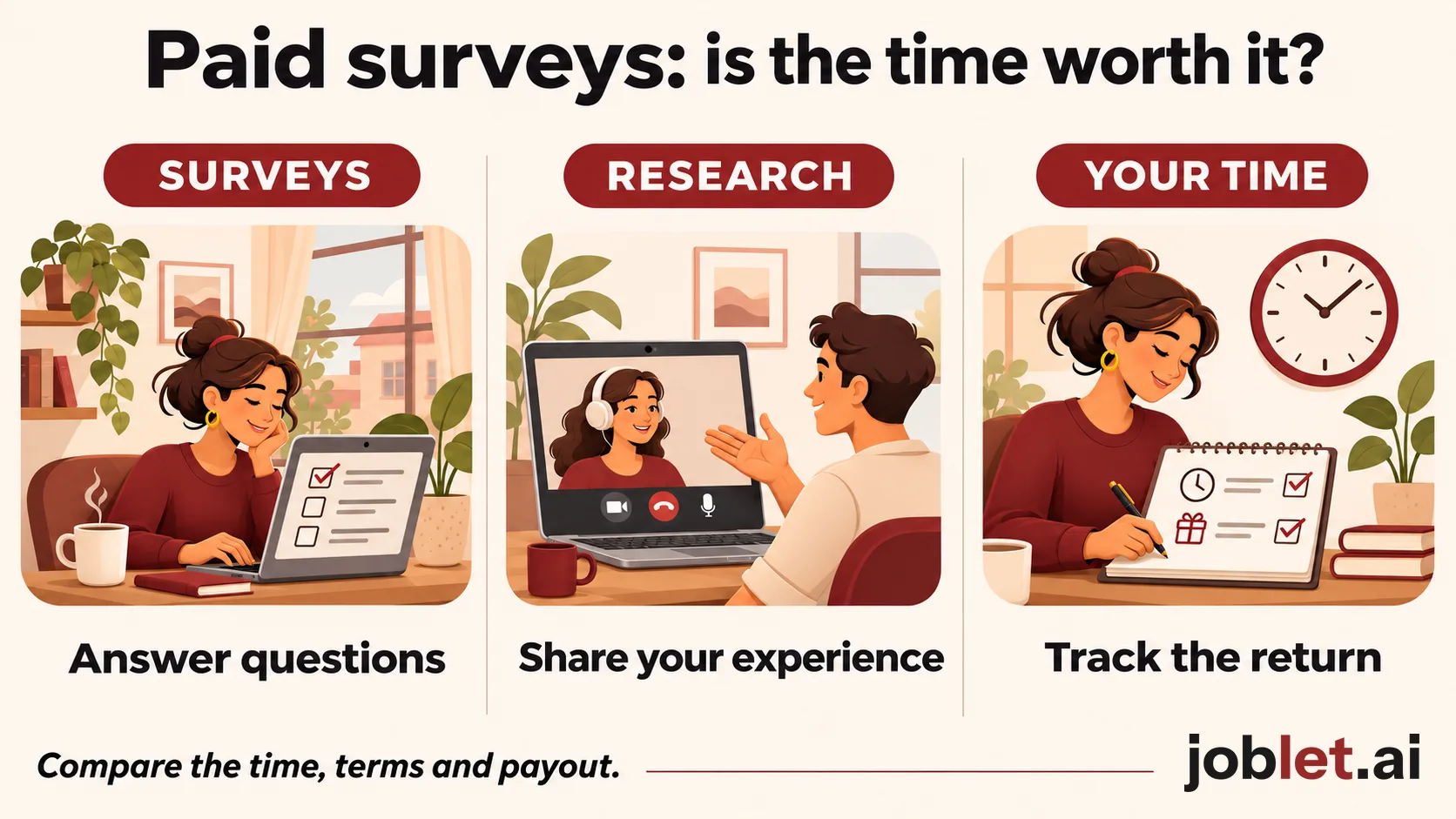
A standard online survey usually involves answering questions about your habits, purchases or opinions. A focus group could mean a scheduled discussion with other participants. A research interview might involve speaking individually with a researcher, while product testing could ask you to try something and report your experience.
Those differences matter when you compare rewards. A payment for a longer research session isn’t a useful benchmark for a short questionnaire. The session may also require a particular professional background, product experience or availability.
Joblet’s paid surveys and gigs page brings together these kinds of postings. Read the responsibilities to see which activity you’re considering.
A listing gives you a chance to apply. It doesn’t mean you’ve been selected or that every applicant will receive the advertised reward.
What “up to” means for your earnings
A high number can catch your attention without telling you what you’re likely to earn.
An “up to” amount is an advertised maximum. It doesn’t establish the payment for every survey or the amount a typical participant will receive. If a posting combines questionnaires with longer research sessions, the larger reward may apply to only one activity.
The useful details are the payment for the specific assignment, its estimated duration and the requirements for qualifying.
Hourly figures need the same context. A study’s participation rate doesn’t tell you how much time you’ll spend finding and qualifying for it. Suppose you receive $3 after spending 45 minutes searching, screening and completing a survey. That works out to $4 an hour across the whole session. It’s a hypothetical example, but it shows why the completed survey’s reward alone can be misleading.
Treat surveys as occasional extra money until your own results give you a reason to expect more.
A balance isn’t always money you can withdraw
Cash, gift cards and points work differently. A large points balance can look impressive without being worth much in dollars. A gift card may be useful for somewhere you already shop, but less appealing if it encourages an unnecessary purchase.
Withdrawal thresholds matter, too. In a hypothetical example, earning $4 on a platform with a $10 redemption minimum leaves you with more work to do before you can access the reward. Once you’re eligible, trying a small withdrawal helps you understand the process before building a larger balance.
There can also be a gap between finishing an activity and having an approved payment. Find out whether submissions need review, how long approval takes and what happens if a submission is rejected.
Payment methods vary by provider. Confirm which method applies to your activity, whether any fees reduce the reward and whether verification is required.
Joblet hosts the postings and helps you find opportunities. The company running the survey, study or gig selects participants and pays them under its own terms. Joblet does not hold or pay out your earnings.
Why you might not qualify
Researchers need responses from particular groups. A study might need people who use a certain product, work in a specific occupation or fall within an age range.
Screening questions establish whether you fit. Sometimes an opportunity already has enough participants in your group.
Being screened out doesn’t necessarily mean you answered incorrectly. The research may simply need someone with a different background. It’s frustrating, though, especially after you’ve spent several minutes answering questions.
An honest, current profile helps you represent your experience accurately. Guessing which answer will qualify you can leave you responding to questions about products you haven’t used or experiences you haven’t had.
Screening time may be unpaid. Before starting a lengthy application, find out whether unsuccessful applicants receive anything for their time.
For scheduled research, selection is only the beginning. The session time, time zone and attendance conditions determine whether it fits your day. A video interview might also require a camera, microphone and a quiet place to participate.
What US participants should know
Eligibility can be more specific than “available online.” An opportunity may require US residency, participation from certain states or a minimum age. Being eligible for one survey doesn’t establish that you qualify for every study from the same provider.
Payment options might include an electronic transfer, a check or a retailer gift card. Confirm that the option offered works for you. A gift card restricted to a retailer you don’t use is different from cash you can spend anywhere.
Survey earnings can also be taxable income. IRS guidance says income from side work generally needs to be reported even when you don’t receive a tax form. Don’t assume a small reward or a noncash payment is automatically tax-free.
Keep records of payments and rewards received, including gift cards. Those records will be more useful at tax time than trying to reconstruct several months of activity from emails.
What you’re agreeing to share
Survey participation involves sharing information about yourself. How much, and for what purpose, is worth paying attention to.
Questions about shopping habits are different from permission to track browsing activity. An interview that records your voice or video asks for something different again. The consent information should explain what’s collected and how it will be used.
Be careful with information belonging to someone else. A study about your work experience shouldn’t become a reason to share confidential employer documents, customer records or private account access.
Pause and investigate if an opportunity asks you to:
- Pay a fee to unlock tasks or release earnings.
- Deposit money before receiving a reward.
- Share your bank login.
- Give someone remote access to your device.
- Make purchases or start an automatically renewing trial to qualify for payment.
Purchase and trial offers need particular care: they introduce costs and cancellation conditions beyond your time. Don’t count the advertised reward without accounting for those obligations.
For more warning signs and ways to verify an opportunity, read the scam-screening section in Joblet’s remote freelance work guide.
Give it a trial run
One or two opportunities are enough to start learning whether this suits you. A separate email address can keep invitations out of your main inbox, and a small time allowance can keep browsing from taking over your evening.
Use a simple record like this:
| Activity | Time spent | Promised | Received |
|---|---|---|---|
| Survey or study name and date | Include searching and screening | Amount, reward type and conditions | Amount or reward received, with date |
After a week or two, you’ll have something concrete to judge. Were suitable activities available? Did the withdrawal process work? Were you spending more time trying to qualify than participating?
You might discover that you prefer occasional research interviews to short surveys. Product testing might be more interesting. Or you might decide that work with regular hours offers a better fit.
Frequently asked questions
Are paid surveys legitimate?
Legitimate survey and research opportunities exist, but a posting alone doesn’t verify every claim. Identify the company running the activity and read its selection and payment conditions before sharing sensitive information.
How much can you realistically earn?
There’s no dependable amount that applies to everyone. Earnings depend on available activities, eligibility, completion time and payout rules. Judge the return using your total time and rewards actually received.
Why do I keep getting screened out?
You may not match the research criteria, or the study may already have enough participants in your group. Repeated screen-outs are worth tracking because that time affects your overall return.
Do I have to pay taxes on survey earnings?
Survey earnings can be taxable. Not receiving a tax form doesn’t automatically make the income exempt. Keep payment records and review the reporting rules that apply to your circumstances.
How do I get paid?
The provider’s terms determine the method and timing. Rewards may be paid in cash, gift cards or redeemable points, sometimes after approval or a minimum balance is reached. Joblet helps you find the posting; the provider handles payment.
Find an opportunity that fits your time
A short questionnaire, a scheduled interview and a product test ask for different commitments. Choose based on the activity, eligibility and payout conditions rather than the largest number in the headline.
Ask Joby: “Show me paid research studies I can do from home this week.”
Explore survey and research opportunities on Joblet. If you need a more regular commitment, compare them with part-time jobs.