

You find a remote job that sounds ideal. No commute, familiar work and the chance to organize your own day. Then you reach the requirements: fixed hours, daily calls and an expectation that you’ll answer messages immediately. You can work from home, but your schedule hasn’t changed much.
Async jobs can give you more room to choose when you work. The catch is that “remote,” “flexible” and “async” describe different arrangements. Understanding the difference helps you find a role that fits your week.
What is an async job?
An async job lets people complete assignments without needing colleagues online for every exchange.
Imagine an editor reviewing a draft. The writer sends the article with a brief and deadline. The editor reviews it later and leaves comments. The writer picks those up during their next working session.
Both people need to deliver on time. They don’t need to spend the afternoon on a call together.
That doesn’t mean there are no meetings. Training sessions, occasional calls and agreed periods of availability can still be part of the role. What matters is whether most assignments can move forward without a live conversation.
Remote, flexible and async mean different things
A remote customer support role might require you to answer calls throughout a fixed shift. You’re outside the office, but you still need to be present at specific times.
Flexible hours give you some choice over your schedule. You might start earlier or finish later while attending a daily meeting during shared working hours.
An async arrangement lets colleagues contribute at different times, with instructions and feedback available for the next person to pick up. A role can combine all three features, but one doesn’t guarantee the others.
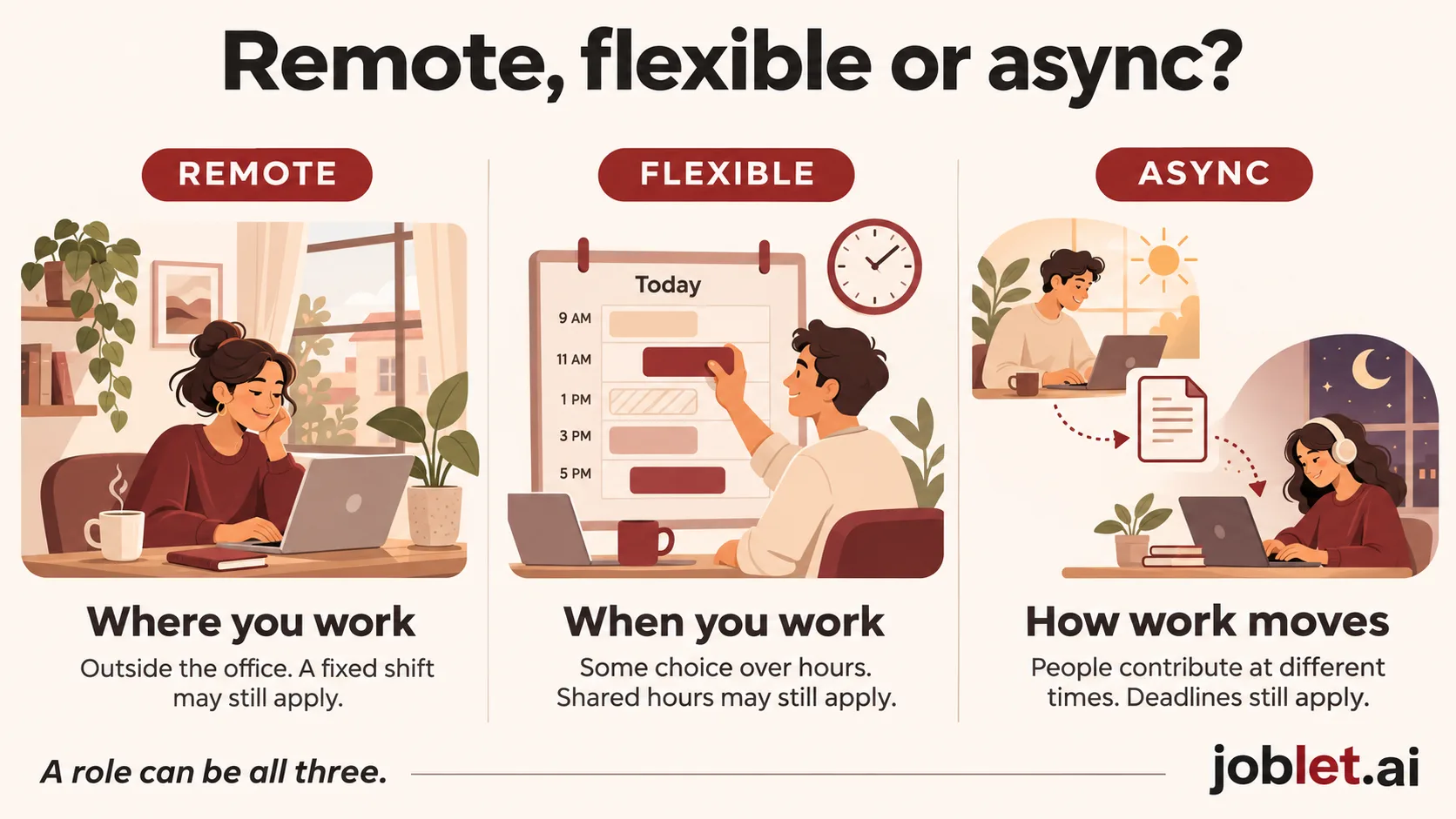
If you’re fitting work around classes, another job or responsibilities at home, those differences matter. A remote role won’t help much if it requires you online during the hours you’re unavailable.
Location rules are separate, too. Choosing your hours doesn’t automatically mean you can work from any country.
Which kinds of jobs can be async?
Look for work with a result that someone else can review later.
A writer can submit an article. A developer can send code for review. A translator can deliver a completed document. An evaluator can assess AI responses against written criteria.
Some roles mix independent work with live collaboration. A designer might develop a proposal alone but attend a client presentation. A developer might have uninterrupted coding time alongside scheduled planning sessions.
The responsibilities tell you more than the title.
You can explore writing, language work, code verification and AI evaluation opportunities on Joblet’s remote and freelance jobs board. For a closer look at evaluation work, read the AI trainer jobs guide.
Ask Joby: “Find me remote writing projects with weekly deadlines and no fixed hours.”
Describe the arrangement you want, then read the results for any scheduling conditions. Joblet hosts the postings; the hiring company sets the requirements, selects applicants and handles payment.
How to tell whether a listing is genuinely async
“Independent work,” “documented processes” and “deadline-based assignments” are useful clues. They’re still worth following up.
“Flexible schedule” could mean you choose your working hours. It could also mean you choose between fixed shifts. A team might communicate through messages but expect immediate replies. If you need to watch the chat all afternoon, you have limited freedom to step away.
Ask the hiring manager to describe a recent assignment. How was it handed over? Could the person complete it independently? What happened when they needed clarification?
A concrete example is more useful than another assurance that the team values flexibility.
Here’s a checklist you can copy into your application notes:
- Which meetings are mandatory, and in what time zone?
- Are there fixed shifts or required overlap hours?
- How quickly must I respond to messages?
- Are deadlines daily, weekly or tied to individual projects?
- Can I complete assignments without colleagues being online?
- Are there minimum weekly hours or availability requirements?
You don’t need a role with no constraints. You need constraints that fit the hours you can reliably offer.
When async work might be a poor fit
Live phone support, incident response and real-time teaching can require scheduled coverage, even when other tasks happen independently. If the main responsibility involves responding immediately, expect limits on when you can work.
Poor organization can create a different problem. You might have time to finish an assignment but be unable to continue because the instructions are incomplete and the person who can clarify them is offline.
During the interview, ask where decisions are recorded and who handles questions. If every answer comes back to “just message someone,” find out what happens when that person is unavailable.
Your preferences matter, too. If you enjoy frequent discussion and quick feedback, long stretches of independent work may feel isolating. A role with some shared hours could suit you better.
Keep the working arrangement separate from the contract
“Async” doesn’t tell you whether you’ll be an employee or contractor, whether assignments are guaranteed or how you’ll be paid.
A salaried role can use asynchronous collaboration. A freelance project might pay hourly, by milestone or per accepted task. Choosing when to work won’t make an unpredictable workload predictable.
Those terms deserve their own review. For help planning assignments, communicating with clients and assessing freelance commitments, see how to manage remote freelance work.
Frequently asked questions
Can an async job still have meetings?
Yes. Occasional calls, training and shared working hours can be part of an async arrangement. Ask how often they happen and whether attendance is mandatory.
Are async jobs always remote?
No. Asynchronous collaboration can happen in office-based or hybrid teams, too. It describes how work is coordinated, rather than where people sit.
Do I need previous async work experience?
Requirements vary. Examples of completing assignments independently, meeting deadlines and documenting your work can help demonstrate relevant skills.
Can I do async work alongside another job?
Possibly, if the deadlines, required availability and contract terms allow it. Compare those requirements with the time you can consistently offer.
Do async jobs pay hourly or per task?
Either is possible. Roles can be salaried, hourly or paid by project, milestone or task. The listing or agreement should explain which activities qualify for payment.
Find an async job that fits your week
Decide when you can attend calls, how much uninterrupted time you have and how quickly you can reasonably respond.
Then compare opportunities against those answers. A weekly deadline may suit you better than daily submissions. A small amount of scheduled overlap may be manageable; a full afternoon of expected availability may not.
Browse remote and freelance opportunities on Joblet, and use the scheduling checklist to assess each role. The right arrangement should be clear enough that you can picture it fitting into a normal week.